
v5.9.8 — LUNA Lab Edition: ADC/DAC Analog I/O
- Digital500 JPY
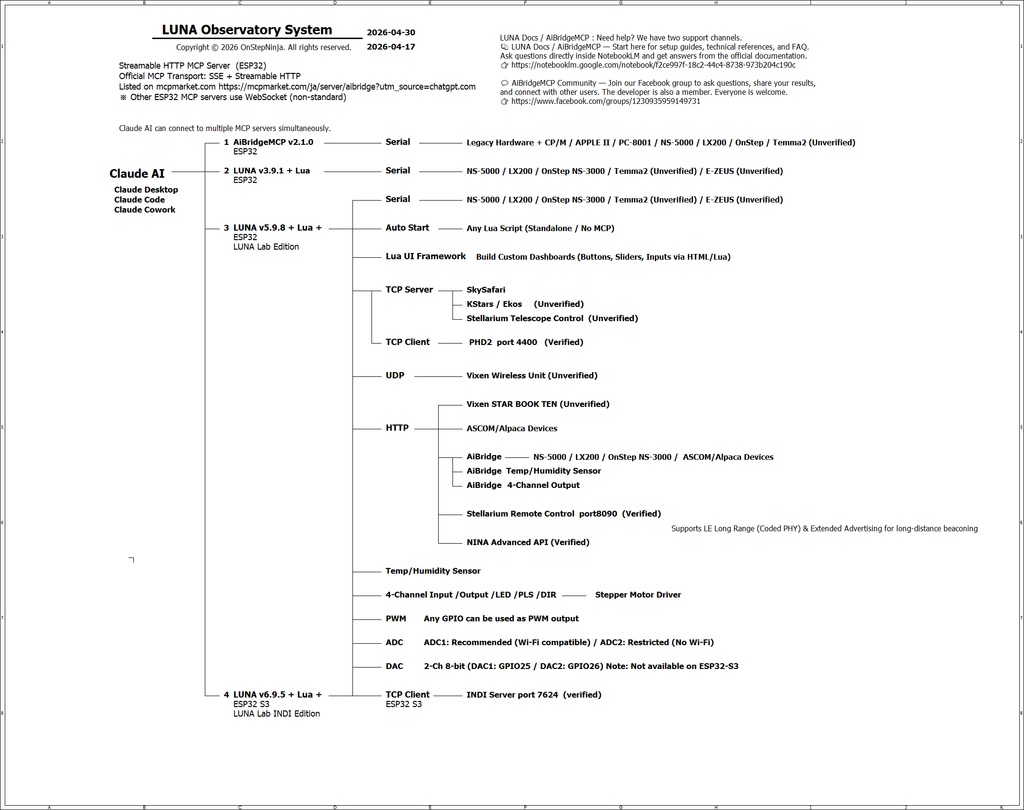

## AiBridgeMCP v5.9.8 — LUNA Lab Edition 🔬 > **From AI Bridge to AI Bridge & Platform.** > LUNA is no longer just a bridge between Claude and your instruments — > it is becoming a programmable AI-native platform for physical computing. --- ### 🆕 What's New in v5.9.8 #### `adc` module — Analog Input (ESP32 ADC1) Read real-world analog voltages directly from Lua scripts. | Function | Description | |----------|-------------| | `adc.atten(pin, db)` | Set measurement range: `0`=0–950mV / `1`=0–1250mV / `2`=0–1750mV / `3`=0–3100mV | | `adc.read(pin)` | Raw 12-bit value (0–4095) | | `adc.read_mv(pin)` | Calibrated millivolts (eFuse correction applied) | | `adc.read_avg(pin, n)` | Average of n readings in mV — reduces noise (recommended n ≥ 16) | **Supported pins:** GPIO32–35 (recommended). GPIO36(VP), GPIO39(VN) are reserved — avoid. **⚠ ADC2 pins conflict with WiFi — use ADC1 only.** --- #### `dac` module — Analog Output (ESP32 hardware DAC) Output true analog voltages — no RC filter required. | Function | Description | |----------|-------------| | `dac.write(pin, value)` | Output 0–255 → 0V to 3.3V. GPIO25 (DAC1) or GPIO26 (DAC2) only. | | `dac.stop(pin)` | Disable DAC output | **Supported pins:** GPIO25 (DAC1), GPIO26 (DAC2, shared with Output 4 on OnStepNinja V2). **⚠ ESP32-S3 has no hardware DAC. Use `gpio.pwm()` + RC filter as a pseudo-DAC.** **⚠ Do not use DAC and PWM simultaneously on the same pin.** --- ### 💡 Verified on Hardware All functions confirmed on ESP32-D0WD-V3: - `adc.read_mv(34)` → 3145 mV ✅ (calibrated, stable) - `dac.write(26, 128)` → 1.72V measured (expected 1.647V, +4.4% — within spec) ✅ - `dac.write(25, 0–255)` → Smooth LED fade confirmed ✅ - Invalid pin rejection (ADC2 / non-DAC pins) → correct error returned ✅ --- ### 🌉 From AI Bridge to AI Bridge & Platform When LUNA first launched, it was designed as a **bridge** — connecting Claude AI to telescopes, serial instruments, and local networks via MCP. With v5.9.8, LUNA takes a step further. By adding true analog I/O (`adc` / `dac`) alongside existing modules (`gpio`, `sensor`, `tcp`, `udp`, `http`, `json`, `ntp`, `ui`, `log`, `ble`...), LUNA is evolving into an **AI-native physical computing platform** — where Claude can not only communicate with devices, but **sense, measure, and directly control the physical world**, all through natural conversation and Lua scripts. > **Telescope control → Sensor logging → Analog experiments → BLE mesh networks.** > One device. One platform. Driven by AI. This opens the door to applications in: - 🔭 Amateur astronomy automation - 🧪 Lab & bioscience experiments (voltage stimulus / response measurement) - 🌱 Environmental monitoring - 🤖 AI-driven robotics and physical computing --- ### 📦 How to Use 1. Flash `AiBridgeMCP_v5_9_8.ino` via Arduino IDE (ESP32 board, Huge APP partition) 2. Connect to WiFi via the setup page 3. Add to Claude Desktop `claude_desktop_config.json` 4. Ask Claude to `get_lua_guide` — then start experimenting! --- ### ❤️ Support the Project on BOOTH This firmware is **free and open** — always will be. If LUNA has been useful to you, the same firmware (pre-compiled binary, ready to flash) is available on BOOTH as a **pay-what-you-feel download**: 👉 **https://onstepninja.booth.pm/** Your support — however small — directly funds continued development. New modules, new editions, new ideas. Every download is a vote for the next version. Thank you. 🙏 --- ### 📄 Changelog - `FIRMWARE_VERSION`: 5.9.7 → **5.9.8** - `EDITION_NAME`: "LUNA" → **"LUNA Lab"** - Added: `adc` module (atten / read / read_mv / read_avg) - Added: `dac` module (write / stop) - Changed: `FILE_MANAGER_LED_PIN` GPIO25 → GPIO33 (frees GPIO25 for DAC1) - Updated: `lua_exec` description, `luna_guide` (adc/dac sections) - Fixed: Lua guide — corrected GPIO25 LED note, GPIO36/39 warning, GPIO26 DAC/PWM caution --- *LUNA — AI Bridge & Platform for the Physical World.* *Solo indie project by Nishioka*